
In case I have told you differently I am back on wfashe3@bellsouth.net for my E Mail address. I flirted with Charter for a few days but gave up when they told me that they would put me on the Internet and after that they could not help me....at least Bellsouth helps me when i am in trouble which is OFTEN. Happy New Year...walter
Saturday, January 14, 2006


Wednesday, November 16, 2005
May 2006 Memorial Program
Pay attention to the registration information in the prior posts. This information is to give you some idea of how the Memorial Service will go. READ THE FULL POST IN COMMENTS section below.
Sunday, November 06, 2005
Sunday, October 09, 2005
Important Links
NAVY DEPARTMENT LIBRARY
DVD - SAND PEBBLES
Dictionary of Fighting Ships - Villalobos
USS PANAY - History
US ASIATIC FLEET COMMUNITY
US ASIATIC FLEET -HYPERWAR
ASIATIC FLEET MEMORIAL PROCLAMATION
FLEET LOCATIONS ON DEC 7 1941
Book - THE FLEET THE GODS FORGOT
Fleet BIOGRAPHY
WIKIPEDIA - ASIATIC FLEET
USS HOUSTON
USS HOUSTON NEWS
DVD - SAND PEBBLES
Dictionary of Fighting Ships - Villalobos
USS PANAY - History
US ASIATIC FLEET COMMUNITY
US ASIATIC FLEET -HYPERWAR
ASIATIC FLEET MEMORIAL PROCLAMATION
FLEET LOCATIONS ON DEC 7 1941
Book - THE FLEET THE GODS FORGOT
Fleet BIOGRAPHY
WIKIPEDIA - ASIATIC FLEET
USS HOUSTON
USS HOUSTON NEWS
Wednesday, September 14, 2005
Put Congress on Social Security
DOESN'T MATTER IF YOU ARE
A Republican or a Democrat
KEEP IT GOING!!!!
2008 Election Issue!!
SOCIAL SECURITY AND CONGRESS
Check out the facts at SNOPES --
A Republican or a Democrat
KEEP IT GOING!!!!
2008 Election Issue!!
SOCIAL SECURITY AND CONGRESS
Check out the facts at SNOPES --
Tuesday, August 23, 2005
Traitor Is About to Be Honored
RE: JANE FONDA....PLEASE HELP BY SENDING THIS TO EVERYONE IN YOUR ADDRESS BOOK. IF ENOUGH PEOPLE SEE THIS MAYBE HER STATUS WILL CHANGEIts important to read the whole story. Its not exactly all true. http://www.snopes.com/military/fonda.asp SEE THIS LINK FOR THE FULL STORY.
Thursday, July 07, 2005
Showing the Flag
GUNBOATS OF THE ASIATIC FLEET

Our member Aaron Anderson wrote the following for his master's degree in College. It is the first extensive review we have had and it is very appropriate while a lot of us are still here and can enjoy "looking back" on those days we have shared together. It comes in four parts and I will publish the first one, "The Beginning" here, and the second part "The Gunboats". The others will be published in forthcoming newsletters. They are The Men, and last The Mission. We thank him sincerely for allowing us to publish it.
THE BEGINNING
America has long maintained interests in China. American commercial and missionary efforts date back to the late eighteenth century, and the United States maintained a naval presence in China dating back to the pre-Civil War era. By the early twentieth century, however, unstable
conditions in China prompted the U.S.Navy to designate a permanent force of gunboats to patrol the Yangtze River, the Pearl River ( leading to Canton), and the China Coast, forming the Yangtze Patrol and the South China Patrol.
Popularized by the novel and movie Sand Pebbles, the gunboats and China sailors represent an important aspect of the American "Old China Hands" experience in China, and duty aboard a gunboat in China was the most unique the Navy had to offer. Was the depiction of the gunboats and sailors in Sand Pebbles accurate? What did the gunboats really do, and what was the life of
the China sailors really like? The U.S. gunboat patrol and their sailors provided vital protection, transportation, and support for American national and private interests in China, and their primary mission to protect American lives, property, and show the flag, was essential to the American presence in China.
The purpose is not to provide a chronological history of the gunboats and sailors in China, but rather to investigate their equipment, activities, duties and mission during the "heyday" of U.S. Gunboat activity in China (1920-1941). The subject will be further addressed in two main
sections in the future; The Men, and The Mission. It is necessary, however , by way of explanation, to offer a brief synopsis of the themes and attributes contained in Sand Pebbles that will be examined, and the events leading up to our era of study (1920-1941), to provide a background and context for the information investigated in this research.

The San Pablo
Sand Pebbles, the 1962 novel by Richard McKenna, provides a vivid representation of life aboard a U.S. gunboat, and the mission they served, in China during the 1920's. McKenna, a real life China sailor who based his novel on actual experiences, portrays certain themes that this
research will address. The fictional gunboat in the novel, the San Pebble (based on the real Villalobas), is portrayed as an antiquated coal burning vessel that is limited in mobility certain times of year by the water level and its draft The sailor' life was good, with plentiful food, comfortable crew quarters, diversions of liberty, and Chinese laborers who lived onboard
research will address. The fictional gunboat in the novel, the San Pebble (based on the real Villalobas), is portrayed as an antiquated coal burning vessel that is limited in mobility certain times of year by the water level and its draft The sailor' life was good, with plentiful food, comfortable crew quarters, diversions of liberty, and Chinese laborers who lived onboard
and did a lot of work. But events intervene, and the Sand Pablo and her men were ordered to evacuate American missionaries out of harms way. They battle Chinese revolutionary soldiers and are able to extricate the missionaries; at a cost (the protagonist is killed). But the gunboat and its sailors are portrayed as well armed and capable of engaging superior numbers of
antagonists (Chinese Revolutionaries) successfully in the course of fulfilling their primary mission: to protect American lives, property, and project American presence by showing the flag.
The United States has been involved with China since the eighteenth century, and the first U.S.flagged merchant ship arrived at Whampoa in Canton on August 28, 1784. American merchant activity continued into the nineteenth century, and in 1844, the Treaty of Wanghsia granted American most favored nation status and extraterritoriality. From that point in time on, the American government assumed the right to protect American flagged shipping in Chinese waters, and began to actively participate in China as both a commercial, and a military power. Events in 1853 proved to be a turning point for the U.S.Navy in China as the Plymouth landed marines in Shanghai to assist the British in securing their concessions, and the Susquehanna marked an essential change in American policy in 1854 by ascending the Yangtze River as far a Wuhu, officially opening the Yangtze River to U.S. naval vessels. Although the Susquehanna was a clumsy paddle-wheel steamer, not really a gunboat, it started the Yangtze Patrol, the "longest uninterrupted military operation in U.S. history (at least inname).
The open treaty ports on the Yangtze eventually included (in order going upriver) Shanghai, Chinkiang, Nanking, Wuhu, Kiukiang, Hankow, Shasi, Changsha , Ichang, and Chungking. After the Civil War, the U.S.sent the Monocacy and the Ashuelot to China, products of U.S. riverine experience in the Civil War, and more appropriate to the conditions on the Yangtze. From 1866 to 1941, there is a continuous U.S naval presence on the Yangtze, indicating that the importance of the commercial invovlvement, and the number of American nationals in the region was growing, and the U.S. felt compelled to maintain a military presence to protect these interests. Also, 1867-1941 represents the actual length of the "longest military operation inthe U.S.history.
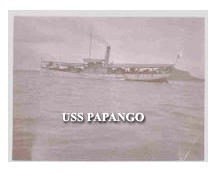
By 1898, several additional U.S.naval ships had served in China and growing American influence in the Pacific began to change the composition, and the importance of the U.S.naval vessels active in the region. The Spanish-American War in 1898 changed the role of the U.S. Navy in the Pacific. Commodore Dewey's victory over the Spanish fleet in Manila Bay on May 1 thrust the U.S.Navy into a new role of protector of a Far East Empire. Additional trouble in China with the Boxer rebellion of 1900 reinforced the Navy's commitment to protect American interests in China, and in 1903 the U.S. moved several vessels captured from the Spanish in the Philippines to China, including the old coal burning gunboatsVillalobos,Elcano, and Pampanga.???????????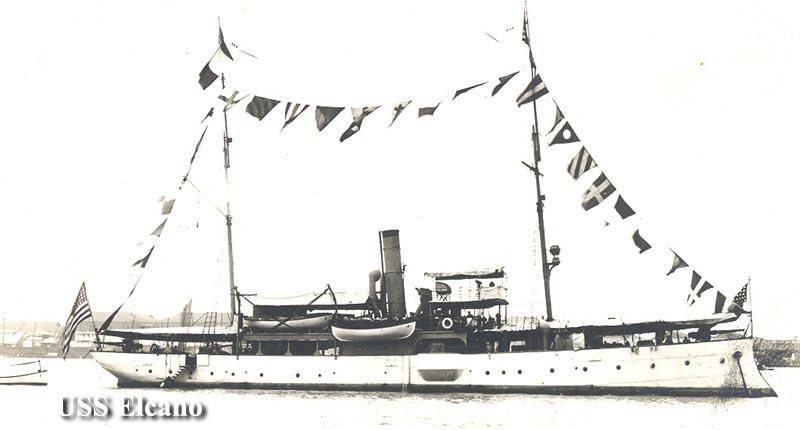
USS ELCANO,
VILLALOBOS
and
PAPANGO
The Pacific Fleet, as the U.S. acknowledged the growing Japanese aims in the region, and the gunboats, were organized into the Second Division, Third Squadron, of the Pacific Fleet in
1908. The Navy commissioned its first specially built shallow draft gunboats in 1914, the  Monocacy and Palos (both replaced old China boats of the same name, decommissioned in 1893 and 1904). The ships were built in the U.S.disassembled, shipped to China in pieces, and reassembled in Shanghai. These gunboats essentially completed the early U.S. complement of gunboats in China, and they gave the Navy the ability to operate in the shallow water of
  Changsha (Tung Ting Lake) and Chungking year-round. World War I also started in 1914, and soon the Americans found themselves the only ones patrolling in China, as other treaty powers (Britain,Russia,Germany, and France) withdrew their gunboat forces or were interned, (the Chinese were still neutral). The U.S.Navy had its own gunboats interned briefly during 1917 as the U.S.entered the war in April and the Chinese did not follow until August. Following the war, the importance of U.S. gunboats in China was even greater (because of the power vacuum created by absent treaty powers and vastly increased American post-war prestige), as China was in constant turmoil and attacks on American interests by war lords and revolutionaries had grown, and would continue for another decade. The U.S. "Dollar Diplomacy" and "Open-Door Policy" in China took the moral high ground, but the fact was, U.S.business was making hundreds of millions in China, and it was the job of the gunboats to protectthese interests.
Due to this increased importance and the growing number of gunboats, on December 28, 1919, the gunboats were organized into the South China Patrol (based in Hong Kong/Canton), and the Yangtze Patrol (based in Shanghai/Hankow). These official designations, and divisions of the
gunboats, would exist for the next two decades, until World War II brought them to an end for good. Thus were the conditions and historical background of the gunboats leading up to our era of study, 1920-1941. This era represents the apex, and swansong, of American gunboats activity in China.
THE GUNBOATS
The first element of this study is the gunboats themselves. The nature and features of the individual gunboats could vary greatly, and this had significant bearing on the kind of experience the crew had, and how effective the boats were in fulfilling their mission. As a general rule,
U.S.gunboats and their crews were well armed, capable of projecting sufficient firepower to prevail in most situations. But the other individual idiosyncrasies and differences between boats deeply affected the lives and moral of the gunboat sailors, where the boats could go, and to a degree determined the level of success they achieved. Some boats were better than others. Consequently, it is necessary to examine the characteristics of the gunboats to provide an understanding and appreciation of these differences.
The gunboats that comprised the early patrols of this era were a decidedly mixed bag. Some were relics captured or purchased in the Philippines during the Spanish-American war; some were manufactured in the States around the turn of the century or during World War I, and were large enough to make the trans-Pacific trip to China, and two, the Palos and the Monocacy, were newertrue river gunboats assembled in Shanghai in 1914.
 USS MONOCACAY
USS PALOS
USS PENGUIN
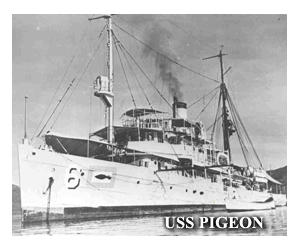
USS PIGEON ASR-6
Many of these gunboats had coal-burning steam engines, while some had been converted or initially fitted with oil burning boilers. Brevity prevents listing all the gunboats used in this early period, but a list for our purposes discussion includes South China Patrol-Helena, Pampanga, Asheville, Pigeon,a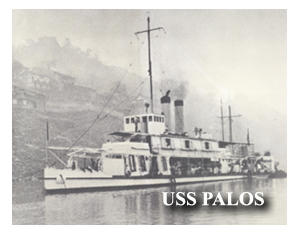 6-1/2 foot draft, was able to cruise the shallow Canton estuary. All were
well armed, however, with main batteries of 4" cannons and machine gun emplacements (the 4" cannon made a distinctive "crack" that terrified the Chinese and could pulverize targets in short order).
But all these ships were primitive relics and none had electrical power, all had to have portable gas generators. They lacked baffles (a component of the firebox/boiler system that trapped heat and could, but this "open flue" stack made the boilers highly not be used with wood because it blocked the flames) and were able to burn wood or coal forfuel .
 Inefficient and the engines weak. The crew quarters were cramped and often below decks, (with the exception of the Villalobos, which had light, airy, wooden crew quarters above deck), making these boats very hot in the summer. The Navy squeezed all the use it could out of these boats, however, and some served until the late 1920's. The common view among the officers about this
group of gunboats might have been summed up by a Navy report from 1920, recommending the Elcano and Villalobos should be "condemned, stricken and offered for sale. Another group of gunboats is the larger ocean going boats guilt in the States. This group includes the Helena, Asheville, and Sacramento. The Helena was a steel gunboat built in 1897 and was one of the first gunboats made specifically for service in China.  She had large view over the 50-foot dikes and banks of the Yangtze. The Sacramento was a steel gunboat built for tropical service in 1914, and the Asheville was a gunboat built for tropical duty in 1918. Both these vessels could burn coal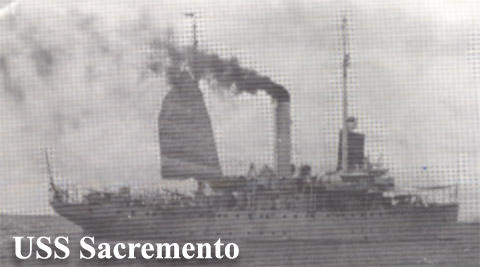
or wood, but were later converted to oil burners. All three boats were well over 200 feet long, averaged 12 knots, and were heavily armed (up to 4" cannons and multiple machine guns). These boats also had large crews (150-185 men) and could carry substantial amounts of fuel, making them well suited for coastal patrol, not river patrol, because their draft averaged more than 10 feet.
 USS ASHEVILLE PG-21
USS SACRAMENTO PG19
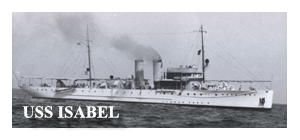
USS ISABEL PY-10
USS OAHU PR-6
USS PANAY PR-5
Three odd-ball (conversion) ships were used during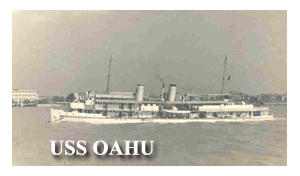 this period: the Isabel, Pigeon, and Penguin. The Isabel was a yacht converted to a destroyer in World War I, and served as flagship for the Commander of the Yangtze Patrol. She was 1probably the fastest of all the gunboats to serve in China: at 26 knots she had blazing speed, but could not go up river past Hankow. The Penguin and the Pigeon were both converted World War I minesweepers. They were
  capable of 13 knots, but had 133-foot drafts, once again preventing upper-river travel. All of these convertedgunboats carried 3" main batteries and machine gun emplacements.
USSTUTUILA PR-4
The only true shallow draft river gunboats during this period were the Monocacy and Palos. Based on British plans, both were constructed at Mare Island Naval 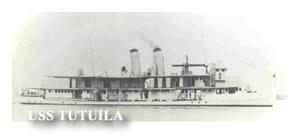 Yard in San Francisco, disassembled, shipped to Shanghai, and reassembled there in 1914. Smaller (165 feet) and lighter (204 tons) that all of the other American gunboats, these boats were true Yangtze gunboats. Able to negotiate the rapids and gorges of the Yangtze to Chungking, they only drew 2-1/2 feet of water, and Far East Commander-in-Chief "fighting Bob:" Evans remarked that they were"almost able to float on wet grass."
These two gunboats were probably the most used and long lived of the early gunboats (used long after their prime), in service until the late 1930's. But even these gunboats had the same and vexing flaw in their designthat plagued other coal burners.
www.jpg) USS GUAM(WAKE)
USS GUAM(WAKE)
o Lt. R.C. Sutliff, Executive officer of the Palos in 1926, the combustion took place in the stack The ships boilers were designed to burn wood or coal, and according t .in order to get up enough steam to shift or sight anchor the stack would belch flames four or five feet out of the top of the stacks. Claude Bailey, "George" officer (Lieutenant Jr. Grade) aboard the Monocacy on her final
trip down the Yangtze in 1938, confirms this: "We did not make more than 5 or 6 knots," because "half our energy went out the stacks in flames..we would have to get underway at five o'clock in the morning and steam until seven o'clock at night to catch up with the other people. We did not have any trouble getting underway in the dark, because the flames from the stack
illuminated the banks of the river. The Navy used these vessels until they barely functioned and the Palos was sold in Chungking in 1937, and the Monocacy was sunk by demolition charges off Shanghai in 1939, making these two of the longest serving gunboats of the Yangtze Patrol.
In 1927-1928, the Navy commissioned six new gunboats to supplement and replace the older gunboats, and these would be the last of the China gunboats constructed. They were as follows: Guam,Tutuila, Oahu, Panay, Luzon, and Mindanao.
The fate of this final series of gunboats is representative of the end of the gunboat era in China. The Mindanao (Flagship South China Patrol), Luzon (Flagship Yangtze Patrol), and Oahu were all withdrawn from China to Manila in the Philippines in December 1941, only to be sunk in Manila Bay in May 1942 (the Luzon was salvaged by theJapanese and named the HIJMS Karatsu).
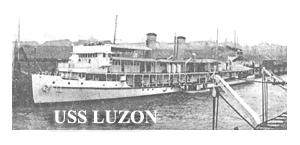 USS LUZON PR-7
Japanese Army planes sank the Panay on the Yangtze near Nanking in 1937.The Tutuila was transferred to Chungking in 1938 with the American Ambassador, and became trapped Japanese blockade of the Yangtze, and was turned over to the Chinese Nationalist government in January 1942. This leaves the Guam, which had the strangest end of all the gunboats (or lack of it). The Navy changed the name to Wake in April of 1941 (the Navy wanted the name Guam for another ship), and it was deemed too small to make the crossing to Manila in December
1941. Consequently, the Japanese captured it in Shanghai on December 8, 1941, and they renamed it the HIJMS Tartara (the Wake was he only U.S. ship captured at the start of World War II). It survived the war and was turned over to the Nationalist, who named it the RCS Tai Juan. When the Nationalist fled the mainland in1949, the gunboat was handed over to the Red Chinese, who put it into service, meaning the boat served under the flag of five different nations.
The gunboats used from 1920-1941 were a mix of a little of everything the Navy could assemble. The South China Patrol and Yangtze Patrol more or less used relics and old coal burning gunboats until 1927-1928, when the newer, much improved oil burning boats were introduced. The old boats were often ill suited to the conditions, particularly where a lot of power and a shallow draft were needed (like the upper Yangtze). The coal burners were susceptible to not only their own idiosyncrasies, but also lack of range due to coal availability. Chinese coal was generally of a low grade and contained many impurities, not ideal for prime boiler efficiency, and half the heat went up the stack on lot of these boats anyway. But the
Patrols did have some very good gunboats for their time.
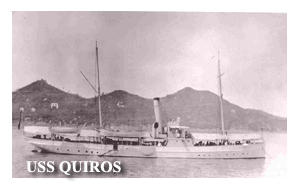 USS QUIROS PG-40

USS MINDANAO PR-8
That's all till next newsletter, and then we will continue with this very interesting review of the gunboats of the United States Asiatic Fleet.
Thursday, June 30, 2005
ChinaGunBoatMan
The ChinaGunboatMan is devoted to perpetuating the history of the Asiatic Fleet. It existed only in the hearts and minds oif those that served in its command. By publishing only true stories of the Philippine-China-Japan area before WWII, that are related to the Asiatic Fleet. we hope to honor only those that served therein. Their good and bad times will make up for future
historians the picture of what happened during those years from 1845 and on in that distant foreign land.
History is made up of these men who served inconspicuously in this far away Asian land, unknown and unheralded by the country they defended. Yet even in their last days, served silently and heroically to the end. The Asiatic Fleet, as we know it, and lived it, is only history. It can never, ever happen again.
We invite all personnel, military or civilian that are interested in, and supportive of, the objectives of the SouthChina Yangtze Patrol to join up with us. You will receive the unique ChinaGunBoatMan newsletter every quarter, you will be qualified to attend our annual reunion and you will enjoy the association with our old "China Hands" that "have been there and done that" duty in the Asiatic Fleet. Welcome Aboard! Send the following information to our Secretary Denver Keplinger, 79 Caesar Circle, Amherst Village, Amherst, OH 44001. Phone (440) 985-2044 or E Mail: Denverkep. Annual dues $18.00 but joining after July lst only $9.00. You will be rewarded with a current ChinaGunBoatMan newsletter when you registration is received.
Saturday, June 25, 2005
Some Background
Walter Ashe is editor for the China Gunboatman's newsletter and served in the USS Asheville. One of the younger members is Kelly Geary whose grandfather was the CO of USS Edsall - Lost without a trace - No survivors. Edsall had just rescued survivors from the USS Langley when it ran afoul of an INJ cruiser. Records do exist from the IJN cruiser that confirm its loss to gunfire. More about the Edsall will be on this blog soon.
History of the Asiatic Fleet
by Walter Ashe
If you ever wanted a story to stir the hearts, and yes, even the souls of Americans, a story of dedication, beyond and above the call to duty, a story filled with courage, a story crying for recognition. This is that story!
It is a story of the Asiatic Fleet, that since 1854, under different names, had been the protector of American lives and property in the Far East, predominantly the Philippines and China.
Our Combined Forces, U.S.Navy Asiatic Fleet survivors are uniting in an effort to bring a long overdue recognition to the heartbreaking struggles of that great fleet, as it fought, alone, against the overwhelming modern Japanese Navy subsequent to the disaster at Pearl Harbor, December 7, 1941. If you have not heard of it, don't worry, you are not alone, not many have.
The Asiatic Fleet, long the peace-keeper in Asia, was the only American naval force available to challenge the onrushing hordes of Japanese forces, hell bent to conquer the oil rich fields of the east Indies, after the disaster at Pearl Harbor. Between this prize, sailed the proud, although overage ships of the Asiatic Fleet. Three cruisers, 13 WW1 vintage destroyers, 29 submarines, auxiliaries, two large gunboats, inshore patrol boats, 6 motor torpedo boats and 36 PBY's. Their orders were to fight the Japanese, to delay their progress. And fight they did!
The U.S. Marines, Navy men and women, also a part of the Asiatic Fleet Command were fighting a fierce delaying action on Bataan and Corregidor, against the Japanese Army sweeping into the Philippines. You have heard of the Bataan Death March? They were in it!
The Asiatic Fleet's only repair facilities at Cavite in the Philippines was destroyed a few days after Pearl Harbor. MacArthur's priceless airforce was wiped out on the ground. That left practically no aircover for the Asiatic Fleet. A disaster for naval vessels as we found out when the mighty British battleships Prince of Wales and the Repulse were sunk by Japanese planes in a few hours. They had no air cover. Also the Houston found out later when they fired at enemy aircraft that a lot of their anti-aircraft shells were defective and would not explode! The submarines had the same heart-breaking results. Some of their torpedoes bounced off the Japanese hulls without exploding! Relief that they thought would be coming momentarily, never came, but fight they continued doing. Sometimes winning, sometimes losing, but gradually falling back to defending new shores. They were more than heroes. They kept fighting when heroes would have stopped!
Little by little, the enemy became stronger and they had to back off. First they defended the American territories and when the Japanese occupied those, they were ordered to join with the Dutch to try and save the oil rich East Indies. The command was turned over to the Dutch and American Commander, Admiral Thomas C. Hart was relieved and returned to the U.S., with deep regret by the officers and men of the Asiatic Fleet. They fought side by side under a command called ABDA (American, British, Dutch and Australians). When there was not any more land to defend and Japanese Fleet had flooded the whole area with ships and planes, they were told to retire to Australia, as best they could, and what was left of them. Some made it, some did not!
If you were to read the story of the "Battle of Balikpapan" in J. Daniel Mullin's book "Another Six Hundred," where four little U.S. World War I vintage destroyers, USS FORD, POPE, PARROTT, and PAUL JONES, undaunted by much superior Japanese naval forces, made a night time attack on a Japanese invasion fleet, miraculously, not only sank several Japanese ships, but escaped to fight another day. You would be very proud of those American sailors. Also and not heralded, as it should have been, this was the first naval engagement against an enemy force since the Spanish American War! That alone should have brought out banner headlines. The lone heavy cruiser, the USS HOUSTON, and destroyers USS JOHN D. FORD and USS POPE had the honor of receiving the Presidential Unit Citation. The USS JOHN D. FORD and USS POPE also were awarded the Philippine, National China, and the US Army Distinguished Unit Citations. The USS HOUSTON died fighting in the Battle of Sunda Strait, wracked by bombs from Japanese planes (The Americans had no air support), punctured by shells, she died firing at the enemy with her decks awash and sinking.
Our light cruiser USS MARBLEHEAD was so badly damaged that she could not carry on and retired from the battle, buried her dead at Tjilatjap and made it back to the United States via India, using pumps all the way to keep from sinking. They saved their ship. The MARBLEHEAD was awarded the Navy Commendation Citation. The destroyers USS POPE,STEWART,PEARY,EDSALL and PILLSBURY fought gallantly but there were just too many against them. They died like the HOUSTON, blasting away at the enemy until the end.
The aircraft carrier USS LANGLEY tried desperately to bring much-needed planes to the American forces, but too late, as by then the Japanese had control of the area, and she too was sunk. The gunboat USS ASHEVILLE, alone, and having fulfilled her duties was heading for Australia and met a large Japanese task force, and was sunk with only one survivor, who later died in the Japanese prison camp in Makassar from inhuman treatment as did many others.
We lost 22 ships, 1,826 killed, 518 placed in prison camps too horrible to describe. Many died there. They were expendable, so it seemed. There were stories (later verified) about sailors being beheaded and others that were doused with gasoline and set on fire. They were beaten, starved and tortured in those beastly prison camps. Some were herded into old rusted Japanese freighters and removed to Japan. Sadly, American planes, not knowing that their comrades were piled into the vessels cargo holds sank many of those ships.
Many of the men who survived the sinking of their ships were left to die in the shark infested waters or were machine gunned while they cried for help. The story of why the crew from the USS POPE were rescued by a Japanese destroyer was an epoch of naval history. When the POPE had been sunk by a Japanese task force and the surviving officers and men were in the water expecting death, a Japanese destroyer approached. The gunnery officer from the POPE , Lt. William R. "Bill" Wilson, had survived and when the destroyer approached he shouted to the Japanese commander in perfect Japanese. He had previously had duty in the Naval Attaché office in Tokyo and had perfected the language. Unbelievable, the Japanese captain happened to have met him in Tokyo and due to that unforeseen coincidence all the surviving men from the POPE were saved. They were taken to a prison camp, but in spite of the misery there, many survived and were released at the end of the war.
The auxiliary ships, held in ports to repair the crippled ships as they limped back from their battles, had no protection from the steady bombing by the Japanese Air Force. They had to cover their ship with palm fronds, and say a prayer as their only means of protection.
The story of the PBY's that flew against the Japanese naval forces was another heartbreaking tale. They dutifully flew bombing raids over the Japanese fleet without any air protection and their big awkward planes, were torn to pieces by the Japanese fighter planes. There were no other planes available and despite the hazards they flew and many died.
And so it happened. It is almost impossible to believe that after all of this heroism, the bitter struggles to obey orders, that not one word of praise or recognition for this fleet was ever given. Can you believe that a display of the combatants in the Pacific during World War II by the National Archives, did not indicate one word in the display that the Asiatic Fleet ever existed ! Can your further believe that in the National Geographic Magazine of December 1991, a fold out map displayed, likewise, all the naval engagements in the Pacific during WWII, and where the Asiatic Fleet fought, died and were imprisoned, there was placed a big Japanese flag, inscribed Java Seas 27 Feb.1942! The day the USS HOUSTON was sunk and other ships met their doom. Is that fair? Did those men die carrying the American flag, only to be remembered as a Japanese victory ? Why? You may ask? Is it because we Americans don't want to illustrate our defeats? Is it because we don't want to be reminded of our losses? Or is it the embarrassment that we allowed it to happen? Did we look the other way when the Asiatic Fleet needed help? Did we only see the problems of Europe or Hitler? Was the conflict in the far, far away Asia mist beyond our cares? Or lastly was it because they did not want to publish such losses after the disaster at Pearl Harbor? History will have the answer, today we can only question it.
If you ever wanted a story to stir the hearts, and yes, even the souls of Americans, a story of dedication, beyond and above the call to duty, a story filled with courage, a story crying for recognition. This is that story!
It is a story of the Asiatic Fleet, that since 1854, under different names, had been the protector of American lives and property in the Far East, predominantly the Philippines and China.
Our Combined Forces, U.S.Navy Asiatic Fleet survivors are uniting in an effort to bring a long overdue recognition to the heartbreaking struggles of that great fleet, as it fought, alone, against the overwhelming modern Japanese Navy subsequent to the disaster at Pearl Harbor, December 7, 1941. If you have not heard of it, don't worry, you are not alone, not many have.
The Asiatic Fleet, long the peace-keeper in Asia, was the only American naval force available to challenge the onrushing hordes of Japanese forces, hell bent to conquer the oil rich fields of the east Indies, after the disaster at Pearl Harbor. Between this prize, sailed the proud, although overage ships of the Asiatic Fleet. Three cruisers, 13 WW1 vintage destroyers, 29 submarines, auxiliaries, two large gunboats, inshore patrol boats, 6 motor torpedo boats and 36 PBY's. Their orders were to fight the Japanese, to delay their progress. And fight they did!
The U.S. Marines, Navy men and women, also a part of the Asiatic Fleet Command were fighting a fierce delaying action on Bataan and Corregidor, against the Japanese Army sweeping into the Philippines. You have heard of the Bataan Death March? They were in it!
The Asiatic Fleet's only repair facilities at Cavite in the Philippines was destroyed a few days after Pearl Harbor. MacArthur's priceless airforce was wiped out on the ground. That left practically no aircover for the Asiatic Fleet. A disaster for naval vessels as we found out when the mighty British battleships Prince of Wales and the Repulse were sunk by Japanese planes in a few hours. They had no air cover. Also the Houston found out later when they fired at enemy aircraft that a lot of their anti-aircraft shells were defective and would not explode! The submarines had the same heart-breaking results. Some of their torpedoes bounced off the Japanese hulls without exploding! Relief that they thought would be coming momentarily, never came, but fight they continued doing. Sometimes winning, sometimes losing, but gradually falling back to defending new shores. They were more than heroes. They kept fighting when heroes would have stopped!
Little by little, the enemy became stronger and they had to back off. First they defended the American territories and when the Japanese occupied those, they were ordered to join with the Dutch to try and save the oil rich East Indies. The command was turned over to the Dutch and American Commander, Admiral Thomas C. Hart was relieved and returned to the U.S., with deep regret by the officers and men of the Asiatic Fleet. They fought side by side under a command called ABDA (American, British, Dutch and Australians). When there was not any more land to defend and Japanese Fleet had flooded the whole area with ships and planes, they were told to retire to Australia, as best they could, and what was left of them. Some made it, some did not!
If you were to read the story of the "Battle of Balikpapan" in J. Daniel Mullin's book "Another Six Hundred," where four little U.S. World War I vintage destroyers, USS FORD, POPE, PARROTT, and PAUL JONES, undaunted by much superior Japanese naval forces, made a night time attack on a Japanese invasion fleet, miraculously, not only sank several Japanese ships, but escaped to fight another day. You would be very proud of those American sailors. Also and not heralded, as it should have been, this was the first naval engagement against an enemy force since the Spanish American War! That alone should have brought out banner headlines. The lone heavy cruiser, the USS HOUSTON, and destroyers USS JOHN D. FORD and USS POPE had the honor of receiving the Presidential Unit Citation. The USS JOHN D. FORD and USS POPE also were awarded the Philippine, National China, and the US Army Distinguished Unit Citations. The USS HOUSTON died fighting in the Battle of Sunda Strait, wracked by bombs from Japanese planes (The Americans had no air support), punctured by shells, she died firing at the enemy with her decks awash and sinking.
Our light cruiser USS MARBLEHEAD was so badly damaged that she could not carry on and retired from the battle, buried her dead at Tjilatjap and made it back to the United States via India, using pumps all the way to keep from sinking. They saved their ship. The MARBLEHEAD was awarded the Navy Commendation Citation. The destroyers USS POPE,STEWART,PEARY,EDSALL and PILLSBURY fought gallantly but there were just too many against them. They died like the HOUSTON, blasting away at the enemy until the end.
The aircraft carrier USS LANGLEY tried desperately to bring much-needed planes to the American forces, but too late, as by then the Japanese had control of the area, and she too was sunk. The gunboat USS ASHEVILLE, alone, and having fulfilled her duties was heading for Australia and met a large Japanese task force, and was sunk with only one survivor, who later died in the Japanese prison camp in Makassar from inhuman treatment as did many others.
We lost 22 ships, 1,826 killed, 518 placed in prison camps too horrible to describe. Many died there. They were expendable, so it seemed. There were stories (later verified) about sailors being beheaded and others that were doused with gasoline and set on fire. They were beaten, starved and tortured in those beastly prison camps. Some were herded into old rusted Japanese freighters and removed to Japan. Sadly, American planes, not knowing that their comrades were piled into the vessels cargo holds sank many of those ships.
Many of the men who survived the sinking of their ships were left to die in the shark infested waters or were machine gunned while they cried for help. The story of why the crew from the USS POPE were rescued by a Japanese destroyer was an epoch of naval history. When the POPE had been sunk by a Japanese task force and the surviving officers and men were in the water expecting death, a Japanese destroyer approached. The gunnery officer from the POPE , Lt. William R. "Bill" Wilson, had survived and when the destroyer approached he shouted to the Japanese commander in perfect Japanese. He had previously had duty in the Naval Attaché office in Tokyo and had perfected the language. Unbelievable, the Japanese captain happened to have met him in Tokyo and due to that unforeseen coincidence all the surviving men from the POPE were saved. They were taken to a prison camp, but in spite of the misery there, many survived and were released at the end of the war.
The auxiliary ships, held in ports to repair the crippled ships as they limped back from their battles, had no protection from the steady bombing by the Japanese Air Force. They had to cover their ship with palm fronds, and say a prayer as their only means of protection.
The story of the PBY's that flew against the Japanese naval forces was another heartbreaking tale. They dutifully flew bombing raids over the Japanese fleet without any air protection and their big awkward planes, were torn to pieces by the Japanese fighter planes. There were no other planes available and despite the hazards they flew and many died.
And so it happened. It is almost impossible to believe that after all of this heroism, the bitter struggles to obey orders, that not one word of praise or recognition for this fleet was ever given. Can you believe that a display of the combatants in the Pacific during World War II by the National Archives, did not indicate one word in the display that the Asiatic Fleet ever existed ! Can your further believe that in the National Geographic Magazine of December 1991, a fold out map displayed, likewise, all the naval engagements in the Pacific during WWII, and where the Asiatic Fleet fought, died and were imprisoned, there was placed a big Japanese flag, inscribed Java Seas 27 Feb.1942! The day the USS HOUSTON was sunk and other ships met their doom. Is that fair? Did those men die carrying the American flag, only to be remembered as a Japanese victory ? Why? You may ask? Is it because we Americans don't want to illustrate our defeats? Is it because we don't want to be reminded of our losses? Or is it the embarrassment that we allowed it to happen? Did we look the other way when the Asiatic Fleet needed help? Did we only see the problems of Europe or Hitler? Was the conflict in the far, far away Asia mist beyond our cares? Or lastly was it because they did not want to publish such losses after the disaster at Pearl Harbor? History will have the answer, today we can only question it.
Subscribe to:
Posts (Atom)